

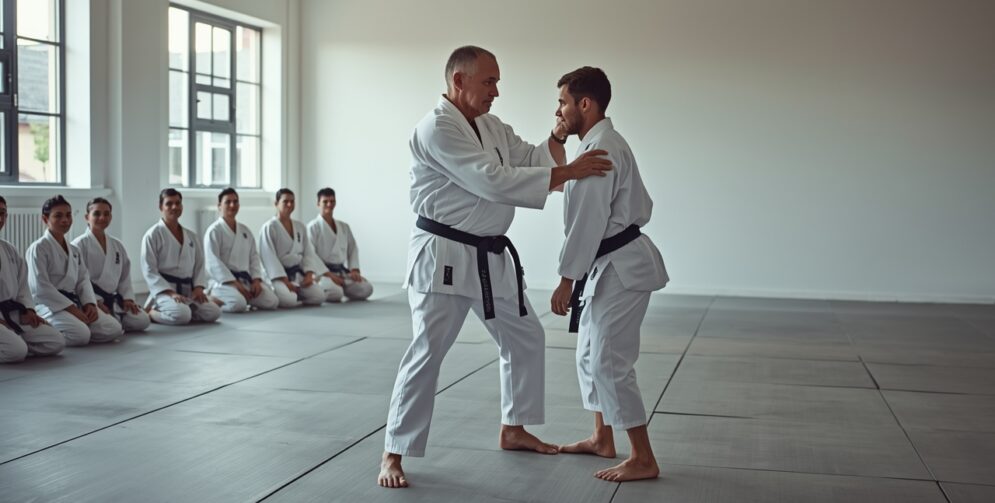
Walk into almost any martial arts school and you will hear the word "Gracie." It is on signs, T-shirts and class names across the country. But a name on the wall is not the same thing as a lineage, and if you are choosing where you or your child will train, the difference matters.
At Gracie Lake Norman in Mooresville, our lineage is direct. Our head instructor, Professor Ranard Brown, is a 3rd degree black belt who trained under Royce Gracie for 13 years and continues his mentorship with Luiz Palhares and Rickson Gracie. Here is where Gracie Jiu-Jitsu comes from, what that history means on the mat today, and how to check any school's lineage for yourself.
Where Gracie Jiu-Jitsu came from
Jiu-jitsu reached Brazil in the early twentieth century through Japanese judo and jujutsu teachers. The Gracie family, led by brothers Carlos and Hélio Gracie, learned the art and then reshaped it.
Hélio was small and not physically strong. Many of the techniques he was taught relied on strength and speed he did not have, so he adapted them. He leaned on leverage, timing and position: controlling a larger opponent from the ground, making them carry his weight, and waiting for the moment a joint or the neck was exposed. That idea, that a smaller person can survive and win against a bigger one if they use leverage instead of force, is the heart of Gracie Jiu-Jitsu.
The night the world noticed
For decades the Gracie approach was mostly known in Brazil. That changed in November 1993, at the first Ultimate Fighting Championship in Denver.
Royce Gracie, one of Hélio's sons, entered as one of the lightest fighters in the tournament. He wore a gi, did not throw big strikes and won all three of his fights that night, taking each opponent down and making them submit. He went on to win UFC 2 and UFC 4 as well.
For martial arts, it was a turning point. People saw that what happens once a fight reaches the ground decides most of it, and that a smaller, calmer person with the right technique could control someone much bigger. Brazilian Jiu-Jitsu spread around the world from there.
From Royce Gracie to Lake Norman
Lineage in jiu-jitsu is personal. Belts are earned from a specific teacher, and that teacher earned theirs from someone else, so every black belt can trace a line back through the people who taught them.
Professor Ranard Brown's line runs straight through the family that built the art. He trained directly under Royce Gracie for 13 years. Today he continues his mentorship with Luiz Palhares, with Rickson Gracie Jiu-Jitsu Global Federation (JJGF) lineage. He has 24 years of training and competing behind him and is ranked #3 World IBJJF Masters Heavyweight.
That is what we bring to Mooresville, Cornelius, Huntersville, Davidson and the rest of the Lake Norman area: not just the name, but the teaching that comes with it.
What lineage changes on the mat
Every school teaches armbars and chokes. Lineage shows up in what a school puts first and how it teaches.
- Self-defense comes first. Gracie Jiu-Jitsu was built for real situations, not points. At Gracie Lake Norman, real-world self-defense comes first, with competition training for those who want it.
- Leverage beats strength. Students learn to escape and control from bad positions using structure and timing. This is why the art works for kids, women and adults over 35, not only for big, athletic people.
- Safety and control. Training is built on controlled sparring and a partner's tap, so students can practise against real resistance without getting hurt.
- Character, not just technique. The Gracie tradition has always been about confidence and calm under pressure. Our Hero's Journey Youth Transformation Program for ages 4–15 is built around life skills, not just moves.
- No egos. Gracie Jiu-Jitsu was built so anyone could learn it, and we work hard to keep our room ego-free and family-style, where beginners are welcome.
How to check any school's lineage
Whether you train with us or somewhere else, a few questions will tell you a lot:
- Who promoted the head instructor to black belt? A real answer is a specific name, and that person should be easy to look up.
- Who do they train with now? Good instructors keep learning. Ask who their coach or mentor is today.
- What does the curriculum put first? If self-defense matters to you, ask how much of the program covers real situations, not only sport rules.
- Can you try it first? A confident school will let you take classes before you sign anything.
If the answers are vague, or "Gracie" is only on the sign, keep looking.
Training at Gracie Lake Norman
Our academy is at 148 Lugnut Lane, Suite 201, in Mooresville: a 4,700 sq ft facility with two training areas, with Gi, No-Gi and open mat. We run classes Monday to Saturday, in the mornings, at lunchtime, in the evenings and at weekends:
- Kids and youth: ages 4–7 and 8–11, through the Hero's Journey Youth Transformation Program.
- Teens: ages 12–17, with advanced technique, live sparring and goal setting.
- Adults: Gi and No-Gi from age 18, plus an Adult 35+ program built for training without injury.
- Women's-only self-defense: every Wednesday, 7–8pm.
- Private 1-on-1 training: 30- or 60-minute sessions, from novice to expert.
We also offer special pricing for first responders, teachers and military, and we are rated 4.9 on Google from 120+ reviews.
The best way to understand a lineage is to feel it on the mat. Start your 7-day free trial, with no contract, and see what Gracie Jiu-Jitsu, taught the way it was handed down, can do for you or your family.
Frequently asked questions
Is Gracie Jiu-Jitsu the same as Brazilian Jiu-Jitsu?
They share the same roots. "Brazilian Jiu-Jitsu" usually describes the art as a whole, including its sport and competition side. "Gracie Jiu-Jitsu" points back to the family that developed it and, at schools like ours, to a focus on real-world self-defense first.
Do I need to be strong or fit to start?
No. The whole idea Hélio Gracie built on is that technique and leverage beat strength. Fitness comes from training; you do not need it before you start.
Is Gracie Jiu-Jitsu good for kids?
Yes. Children learn to fall safely, stay calm, stand up for themselves and respect their partners. Our kids' and youth classes focus on coordination, listening, anti-bullying skills and teamwork.
How do I get started?
Book your 7-day free trial. There is no contract, and our coaches will help you find the right class for your age and goals.
