

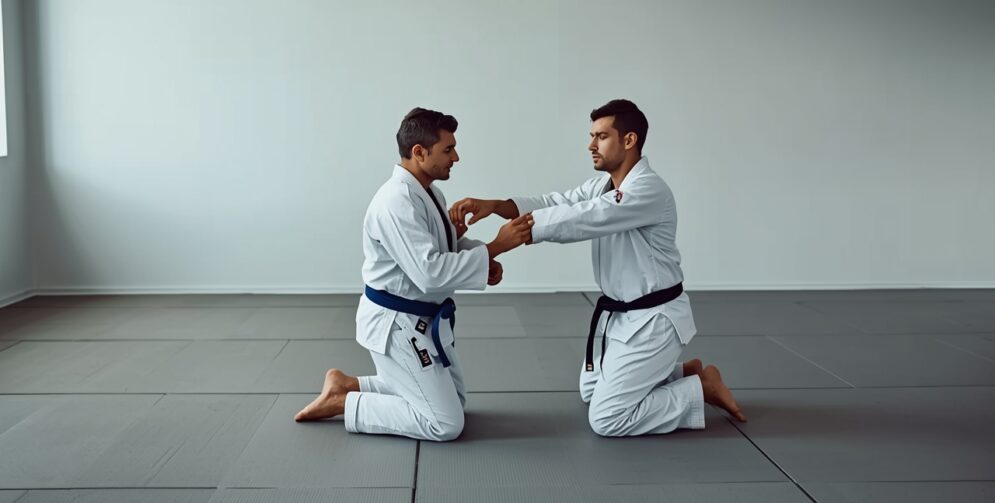
A quarter-inch adjustment in your elbow placement can mean the difference between escaping a side control pin cleanly and getting trapped under three hundred pounds of pressure for five minutes straight. In a standard group class, an instructor breaks down a movement for twenty people, walks the floor to spot glaring errors, and moves on to live sparring. That structure builds a broad foundation. But when a technique continually fails against resisting partners, general instruction rarely catches the micro-friction holding you back.
If you are spending hours on the mat each week only to get stuck in the exact same bad positions, you are not alone. Most grapplers reach a point where adding more group classes only repeats bad habits. To fix persistent technical gaps, protect your body from unnecessary wear, or master specific self-defense scenarios, you need direct, individualized feedback.
Over 24 years on the mat, I have watched grapplers hit wall after wall trying to figure out positional problems by trial and error during chaotic group sparring. Personalized coaching isolates your exact mechanical flaws in real time. At Gracie Lake Norman, a Brazilian Jiu-Jitsu and self-defense academy in Mooresville, North Carolina, we use structured private training to systematically audit a student's movement patterns and rebuild their technical base.
In this guide, you will learn how targeted individual sessions work, what to expect regarding private jiu jitsu cost, how to apply the 80/20 rule to your training, and how to structure your time off the mat to get maximum value from every minute of one on one martial arts training.
Breakthroughs Happen in the Micro-Details
Is BJJ good for physical conditioning, practical self-defense, and building mental resilience across all ages? Yes. Brazilian Jiu-Jitsu uses leverage, weight distribution, and joint mechanics to allow a smaller practitioner to neutralize larger opponents without relying on brute strength. However, executing those mechanics requires precision.
When you practice a technique in group classes, you receive broad mechanical cues. You learn where your hands go, where your feet plant, and which way to turn your hips. What group classes cannot always offer is immediate physical feedback on force application.
During one-on-one sessions, your instructor feels your weight distribution directly. They can tell you instantly when your weight sits two inches too far back, leaving you vulnerable to a sweep, or when your grip lacks the proper angle of engagement.
Standard Group Class Flow:
[Technique Demonstration] -> [Partner Drilling] -> [General Room Correction] -> [Live Sparring]

Private Instructional Flow:
[Positional Audit] -> [Micro-Mechanical Adjustment] -> [Targeted Pressure Testing] -> [Immediate Re-Correction]
This direct feedback loop eliminates the guessing game. Instead of spending six months attempting an ineffective guard pass during open mat sparring, an hour of targeted observation pinpoints why your base collapses. Fixing structural posture errors instantly restores your efficiency on the mat.
How Private Instruction Solves Specific Training Obstacles
Every practitioner comes to the mat with a unique body type, athletic history, and learning style. A standard curriculum must cater to the average student in the room, which means specific edge cases fall through the cracks. Focused individual sessions bridge that gap for four distinct groups of practitioners.
Adults 35 and Older: Training Around Injury and Longevity
Grapplers over 35 often cannot train with the same explosive, reckless intensity as a 20-year-old collegiate wrestler. Relying purely on scramble speed or forcing flexed positions leads directly to spinal compression, joint inflammation, and extended time off the mat.
In a private setting, the material adapts entirely to your joint mobility and physical limits. Research on sports injury prevention published through the National Institutes of Health emphasizes that controlling joint angles and movement volume drastically reduces overuse injuries in contact athletics. Private instruction lets you build an ego-free, conservative game centered on heavy pressure, defensive frames, and energy conservation, ensuring you can train safely for decades.
Women Seeking Functional Self-Defense
Many women enter a martial arts facility looking for practical self-defense techniques to protect themselves in real-world situations, but find intimidating, male-dominated environments frustrating. Group sparring often pairs women with partners who either hold back completely, rendering the drill useless, or use overwhelming physical weight without control.
Individual lessons offer a controlled, highly supportive environment. You work through real-world violent scenarios, such as wrist releases, shirt grabs, bear hugs, and ground pins, against calibrated resistance. You learn to apply leverage against larger body frames step by step, building real physical confidence before stepping into full group sparring.
Parents and Children: Customized Behavioral and Skill Development
Children develop motor skills, attention spans, and emotional regulation at vastly different rates. In a group environment with fifteen other kids, a child who struggles with focus or spatial awareness can quickly become overwhelmed.
Through personalized youth training, instructors adjust their teaching cadence to match the child's learning pace. This approach is especially powerful for neurodivergent children, including those on the autism spectrum or with ADHD. By breaking complex multi-step drills down into single-step physical games, private instruction builds focus, physical coordination, and emotional resilience without public pressure.
First Responders and Law Enforcement
Police officers, firefighters, and military personnel require defensive tactics that work under extreme stress while remaining within legal control protocols. Generic sports BJJ, which often encourages playing off your back or risking positional control to hunt for joint locks, does not align with professional duty standards.
One-on-one training allows law enforcement officers to drill specific control tactics: managing distance, securing weapon retention, applying non-lethal positional dominance, and safely controlling an aggressive subject on the ground.
Applying Pareto's Principle: The 80/20 Rule on the Mat
What is the 80/20 rule in BJJ? The 80/20 rule in BJJ dictates that 80 percent of your success on the mat comes from mastering 20 percent of core foundational movements. Focusing private training on these essential leverage points yields faster defensive control than collecting dozens of low-probability submission attempts.
Many beginners get distracted by flashy, complex moves featured on social media. They try inverted guards, flying attacks, and intricate leg entanglements before mastering basic hip movement or posture control. When those advanced moves fail, they lack the defensive mechanics to recover.
 CORE FOUNDATIONAL MOVEMENTS (20%)
 +-----------------------------------------+
 | • Hip Escapes & Framing |
 | • Posture Control & Base Maintenance | ===> 80% OF MAT SUCCESS
 | • Weight Distribution & Pin Escapes | (Defensive Control & Survival)
 | • Distance Management & Grip Breaking |
 +-----------------------------------------+
An experienced coach uses private sessions to force your attention back to the essential 20 percent:
- Framing mechanics: Using your skeletal structure rather than muscle strength to keep heavy opponents from flattening your chest.
- Hip escapes (shrimping): Creating space between your hips and your opponent to rebuild guard position.
- Base and posture: Keeping your spine aligned so an opponent cannot pull your head down or break your balance.
- Underhooks and cross-faces: Controlling your opponent's upper body to prevent them from turning into you or taking your back.
Mastering these core principles creates a defensive system that works against any opponent, regardless of their style, strength, or weight class.
Comparing BJJ Development Tracks
To decide how to allocate your monthly training time and budget, compare how different class structures deliver technical value, physical conditioning, and skill retention.
| Feature | Group Classes | Private Lessons | Hybrid Model (Recommended) |
|---|---|---|---|
| Primary Focus | General curriculum, positional exposure, broad drilling | Targeted problem-solving, structural repairs, customized game-plans | Comprehensive foundation plus personalized technical auditing |
| Partner Variety | High (multiple body types, skill levels, and athletic styles) | Low (direct work with your instructor or dedicated training dummy) | High (varied partners to test concepts refined in private sessions) |
| Feedback Frequency | Periodic during drill rounds | Instantaneous with every single rep | Continuous loop between private analysis and group execution |
| Schedule Flexibility | Fixed class times set by academy schedule | Scheduled directly around your personal calendar | Standard class attendance supplemented by flexible appointment blocks |
| Cost Structure | Included in standard monthly membership | Higher hourly rate based on instructor credentials | Monthly membership plus targeted 1-on-1 sessions before events or gradings |
For grapplers looking for accelerated progress, the hybrid model is unmatched. Group classes provide the varied body types and unpredictable energy required to test your moves, while direct private lessons isolate why specific moves failed during those live rolls.
Cost Considerations and Evaluating Value
Understanding private jiu jitsu cost helps you budget effectively while building an efficient training routine. Hourly rates for individual instruction vary widely based on geographical location, facility amenities, and the instructor's direct lineage and coaching credentials.
Across the martial arts industry, standard rates generally fall into three tiers:
- Blue or Purple Belt Assistant Instructors: $40 to $75 per hour. Useful for fundamental repetitions, basic positional walk-throughs, and simple cardio-drilling sessions.
- Brown or Black Belt Instructors: $80 to $150 per hour. The industry standard for deep technical analysis, game planning, positional diagnostics, and subtle mechanical fixes.
- World Champions or High-Profile Seminar Leaders: $200 to $1,000+ per hour. Typically reserved for advanced competitors seeking specialized elite-level competition strategies.
When evaluating private training costs, look beyond the flat hourly rate. A single targeted hour with a seasoned black belt who immediately identifies why your guard is getting passed can save you six months of frustrating trial and error.
To maximize your investment, consider booking a 30-minute focused session dedicated to a single position rather than a broad 60-minute session where focus drifts. Alternatively, split a private session with a training partner of similar weight and skill level. Semi-private lessons reduce your individual cost by half while giving your instructor a realistic sparring dynamic to observe from the side.
A 4-Step Framework to Maximize Your Investment
Showing up to a private lesson without a clear strategy wastes both your time and your money. If your instructor asks what you want to work on and your answer is "everything," you have already lost half the value of the session. Use this four-step framework to prepare for every private lesson.
+-------------------------------------------------------------------+
| STEP 1: Keep a 14-Day Training Log |
| Document exact positions where you get stuck or submitted. |
+-------------------------------------------------------------------+
 |
 v
+-------------------------------------------------------------------+
| STEP 2: Define ONE Positional Problem |
| Narrow your focus (e.g., "Escaping side control when pinned"). |
+-------------------------------------------------------------------+
 |
 v
+-------------------------------------------------------------------+
| STEP 3: Record and Take Detailed Notes |
| Write down mechanical cues immediately after the session. |
+-------------------------------------------------------------------+
 |
 v
+-------------------------------------------------------------------+
| STEP 4: Execute 50 Deliberate Reps in Group Sparring |
| Force the position in live rolls to validate the fix. |
+-------------------------------------------------------------------+
Step 1: Keep a 14-Day Mat Log
For two weeks prior to your scheduled lesson, keep a small notebook in your gym bag. Immediately after every group class or open mat session, write down the answers to three basic questions:
- Which position did I spend the most time stuck in today?
- Which specific sweep or submission did my partners use to catch me?
- Where did I feel physically exhausted or mechanically weak?
Step 2: Define One Specific Positional Problem
Review your notes and select your single biggest bottleneck. Do not ask your coach to teach you "guard passing." Ask: "When I am in closed guard and try to posture up, my opponent breaks my collar grip and pulls my head down. How do I clear that grip without leaving my arm open to a triangle choke?"
Step 3: Record and Document the Mechanics
Before your session begins, ask your instructor if you can record a 60-second summary video at the end of the hour. Most instructors gladly accommodate this request. During the session, keep your notebook on the edge of the mat. Write down key mechanical cues right after drilling them: elbow tucked inside the hip bone, lead knee turned 45 degrees outward, palm up on the belt line.
Step 4: Force the Position in Group Sparring
A private lesson does not end when you step off the mat. For the next three weeks of regular group classes, intentionally place yourself in the exact position you spent your private session fixing. If you spent an hour working on escaping bottom side control, let your training partners pass your guard immediately during live rolls so you can practice your new escape under real pressure.
Positional Escape Micro-Drill: The Hip-Frame Diagnostic
To understand how technical adjustments dramatically improve performance, look at one of the most common problems in martial arts training: escaping bottom side control when a heavy opponent flattens your shoulders to the mat.
Many grapplers try to push their opponent directly off them using raw arm strength. This burns out the shoulders and triceps within seconds while accomplishing nothing against a heavy opponent.
Incorrect Pushing (Muscular):
Opponent Pressure (Downwards) <--- [Straight Arm Push] (Fails/Exhausts Triceps)

Correct Frame (Skeletal Structure):
Opponent Pressure (Downwards) ---> [Forearm Frame on Collarbone] ---> Ground Transfer
 ^ [Elbow Block on Hip Bone]
Use this diagnostic frame drill during your next training session to practice relying on skeletal mechanics rather than muscle:
- Set the Forearm Frame: Place your top forearm across your opponent's collarbone with your hand open and your palm resting flat on their far shoulder. Keep your elbow bent at a 90-degree angle tight to your own body. This transfers their chest weight directly into your skeletal frame rather than forcing your arms to carry it.
- Set the Hip Block: Place your bottom hand flat against your opponent's hip bone, tucked tight into your waistline. This prevents them from sliding their hips up toward your armpit to flatten you out.
- Perform the Bridge: Plant your feet flat on the mat close to your glutes. Drive off your feet to bridge your hips upward diagonally over your shoulder toward your opponent. This creates a moment of weightlessness and forces them to post a hand for balance.
- Execute the Hip Escape (Shrimp): As your opponent's weight shifts off your chest, immediately shoot your hips backward away from them while extending your legs. Your structural frames hold the space open while your hips move back freely.
- Insert the Knee Shield: Bring your bottom knee straight up through the space you just created between your chest and their hips, recovering your guard safely.
In an individual coaching session, your instructor will physically pressure this frame from multiple angles to ensure your skeletal alignment holds up effortlessly without relying on arm strength.
Private Lesson Diagnostic Checklist
Before booking a lesson for yourself or your child, run through this diagnostic checklist to determine whether you are truly ready to get full value from the session.
- I have logged at least 10 to 15 group sparring sessions and can name the specific positions where my defense consistently breaks down.
- I am clear on my primary goal, whether that is preparing for an upcoming tournament, addressing a chronic joint issue, learning self-defense basics, or solving a specific technical plateaus.
- I have a designated training partner available to join the session if my coach prefers to watch and correct mechanics from the side rather than act as the primary drilling dummy.
- I have cleared my schedule for 15 minutes after the session to sit down, review my notes, and write down every detail before motor memory fades.
- I have arranged my regular weekly training routine so I can attend group classes or open mats immediately following the lesson to test out the new mechanics under live pressure.
Common Misconceptions About Age and Experience
Many grapplers delay getting personal coaching because they believe it is reserved exclusively for elite competition teams or high-ranking black belts. This assumption holds practitioners back unnecessarily.
Is 25 Too Late to Start BJJ?
Starting BJJ at 25 is far from too late. In fact, many practitioners begin in their 30s, 40s, or 50s and achieve black belt proficiency, as Jiu-Jitsu relies on technique, posture, and efficiency rather than youth-driven raw athleticism.
Starting in your mid-twenties gives you an ideal balance of adult physical maturity, focus, and body control. At this age, you can process complex spatial mechanics much faster than a young child, allowing you to absorb technical concepts quickly.
Technical Depth Across Experience Levels
Another common myth is that high-level black belts only focus on advanced, fancy competition moves. High-level grapplers demonstrate extraordinary mastery over fundamental concepts: posture, leverage, distance, and base control.
Consider high-profile practitioners in mainstream media. What level BJJ is Joe Rogan? Joe Rogan holds a black belt in Brazilian Jiu-Jitsu under Jean Jacques Machado (Gi) and Eddie Bravo (10th Planet No-Gi). He earned both black belts after decades of dedicated mat time and technical study. High-level black belts like Rogan consistently stress that basic positioning and defensive survival are what make the art effective for anyone, regardless of age.
 MASTERY PROGRESSION IN JIU-JITSU
+-----------------------------------------------+
| NOVICE: Focuses on collecting techniques |
| (Tries dozens of high-risk moves) |
+-----------------------------------------------+
 |
 v
+-----------------------------------------------+
| BLACK BELT: Focuses on micro-details |
| (Perfects base, weight distribution, frames) |
+-----------------------------------------------+
A total beginner benefits just as much from an hour of personal instruction as an advanced competitor. For a beginner, a single session builds correct safety habits, proper fall-break mechanics, and essential guard posture from day one, preventing bad technical habits that take years to undo later.
What to Expect at Gracie Lake Norman
When looking for private bjj lessons mooresville or throughout the broader Lake Norman region, lineage and instruction standards matter. Gracie Lake Norman operates out of a 4,700-square-foot facility at 148 Lugnut Lane, Suite 201, in Mooresville, North Carolina, serving students from Cornelius, Huntersville, Davidson, and the surrounding areas.
Our academy is led by Professor Ranard Brown, a 3rd-degree black belt with 24 years of experience training and competing. He trained directly under Royce Gracie for 13 years and continues under Luiz Palhares, maintaining direct Rickson Gracie JJGF lineage standards.
We structure customized training programs across all age groups and skill levels:
- Youth & Teen Programs: Structured youth classes for ages 4 to 7, 8 to 11, and 12 to 17, featuring the Hero's Journey Youth Transformation Program designed to build confidence, discipline, and physical coordination (including tailored support for neurodivergent children).
- Adult Programs (18+ and 35+ Track): Gi and No-Gi sessions focused on heavy pressure, energy conservation, and safe longevity on the mat.
- Women's-Only Self-Defense: Practical real-world self-defense classes offered in a supportive, ego-free community.
- Private 1-on-1 & Semi-Private Sessions: 30-minute or 60-minute targeted instruction blocks built around your specific technical goals, physical limitations, or scheduling requirements.
- Specialized Pricing: Dedicated membership tiers with special rates for first responders, law enforcement officers, teachers, and active or veteran military personnel.
Every new student starts with a 7-day free trial with no contract requirements, letting you experience our training community firsthand.
Take the Next Step
If you are ready to break through your current mat plateau, fix persistent positional mistakes, or start your martial arts journey with structured personal guidance, let's talk. Contact Professor Ranard Brown and the team at Gracie Lake Norman to discuss your specific goals and schedule your initial diagnostic session. Claim your 7-day free trial today and take complete control of your progression on the mat.
Frequently asked questions
Is BJJ good for self-defense and overall fitness?
Yes. Brazilian Jiu-Jitsu is one of the most effective martial arts for self-defense because it focuses on leverage, joint locks, and positional control to neutralize aggressive opponents without relying on strikes or raw physical strength. It delivers a full-body workout that improves cardiovascular endurance, core strength, joint flexibility, and stress management across all age groups.
What is the 80/20 rule in BJJ?
The 80/20 rule in BJJ states that 80 percent of your overall success comes from mastering 20 percent of essential core movements. These fundamentals include hip escapes, proper framing, spinal alignment, posture control, and distance management. Focusing your training on these core mechanics delivers better defensive control than learning dozens of low-probability submission moves.
What level BJJ is Joe Rogan?
Joe Rogan is a 3rd-degree black belt in Brazilian Jiu-Jitsu under Jean Jacques Machado (Gi) and holds a black belt under Eddie Bravo (10th Planet No-Gi). He has practiced martial arts for decades and frequently discusses the physical and mental resilience developed through consistent BJJ training.
Is 25 too late to start BJJ?
No, 25 is a fantastic age to start Brazilian Jiu-Jitsu. Practitioners routinely begin their training in their 30s, 40s, and 50s and progress to black belt rank. At 25, you possess an ideal combination of adult focus, emotional discipline, and physical motor control, allowing you to absorb technical concepts quickly.
